[Norway] Troll

Post Reply
escveritas
Site Admin
Posts: 3699
Joined: Sat Aug 29, 2020 5:40 am
Location: Singapore
Contact:
Singapore

In April 2020, the world’s largest pipelaying vessel, the Solitaire, completed laying 26 kilometres of new pipeline between the Troll A platform and the new subsea installations of the Troll Phase 3 project. It’s our most profitable project ever, with a break-even of just USD 10 per barrel.

The Troll field lies in the northern part of the North Sea, around 65 kilometres west of Kollsnes, near Bergen.
The field comprises the main Troll Øst and Troll Vest structures in blocks 31/2, 31/3, 31/5 and 31/6.

Containing about 40 per cent of total gas reserves on the Norwegian continental shelf (NCS), it represents the very cornerstone of Norway’s offshore gas production.

Troll is also one of the largest oil fields on the Norwegian continental shelf. In 2002 the oil production was more than 400,000 barrels per day.

We operate the Troll A, B and C platforms and the landfall pipelines, while Gassco is operator for the gas processing plant at Kollsnes on behalf of Gassled. Equinor is technical service provider for Kollsnes operations.

The enormous gas reservoirs lying 1,400 metres below sea level are expected to produce for at least another 70 years.

PROVEN IN 1979

Norske Shell was chosen as operator when block 31/2 was awarded in April 1979. A large gas find with an underlying oil zone was proven later that year. The block was declared commercial in 1983.

The neighbouring blocks were awarded to then Statoil, now Equinor, Norsk Hydro and Saga Petroleum in 1983.

Block 31/2 contains 32 per cent of the Troll field’s reserves, while the remaining 68% lies in the three other blocks.

The licence terms for block 31/2 specified that Equinor could take over as operator for this acreage eight to 10 years after a discovery had been declared commercial.

In 1985, the two licences were unitised so that Troll could be developed as a single field.

Equinor took over as production operator for Troll Gas on 19 June 1996, while Hydro started production from Troll Oil in the fall of 1995.

TROLL GAS

Troll Gas comprises the Troll A platform, the Kollsnes gas processing plant west of Bergen and the pipelines between the platform and the land plant.

Norske Shell was responsible for the first gas development phase on Troll, which received a green light from the Norwegian parliament (Storting) in December 1986. Four years later, we agreed with Shell to move the processing facilities originally due to be installed on the A platform to a plant on land at Kollsnes west of Bergen. This made it possible to build a simpler offshore gas production installation than originally planned, with smaller staffing.

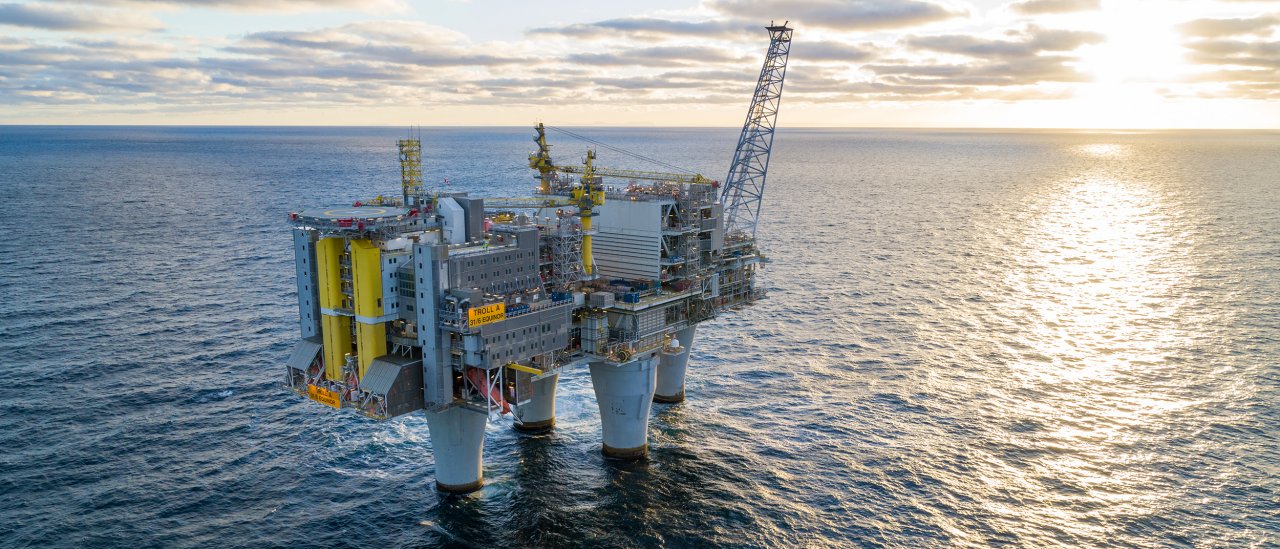
Troll A is the tallest structure ever moved by humans over the surface of the Earth. Its concrete support section has been built for a producing life of 70 years. The platform is the only one of its kind on the NCS that is powered electrically from land.

We took over as operator for Troll Gas from Norske Shell on 19 June 1996 with gas coming on stream in the first half of that year, marking the completion of the gas development. Contractual gas deliveries began flowing from the field to continental Europe under the Troll gas sales agreements on 1 October 1996. Initial deliveries under these contracts, which began on 1 October 1993, were provided from our Sleipner Øst development in the North Sea.

Declining pressure in the Troll reservoir means that more compression is needed to help drive gas production through the pipelines to the processing plant at Kollsnes. Two compressors have accordingly been installed on the A platform, and new technology allows these units to be powered from land. That in turn means zero carbon dioxide and nitrogen oxide emissions from the installation or the processing plant.

TROLL OIL

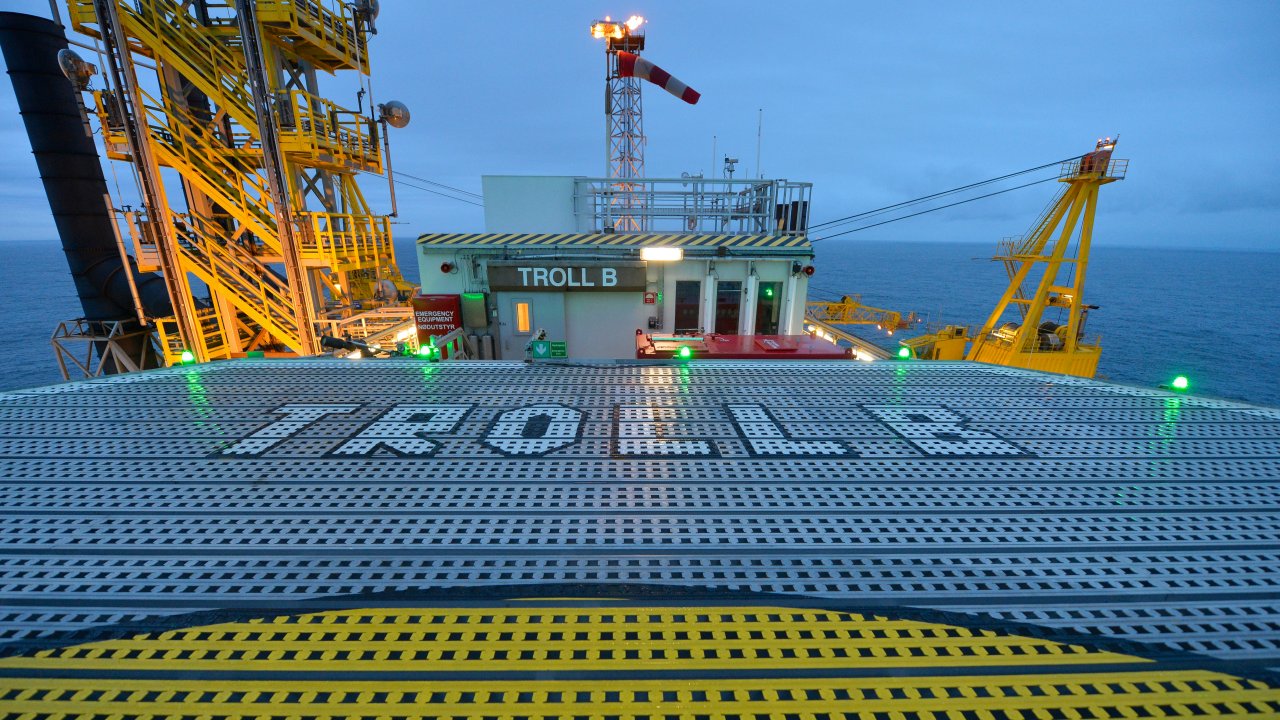
Troll B, a floating process and accommodation platform with concrete hull, and Troll C, a floating process and accommodation platform with a steel hull, produce from thin oil-bearing layers in the Troll Vest reservoir.

The thin oil layer is between 22 and 26 meters in the Troll Vest oil province and 11 and 13 meters in the Troll Vest gas province. In order to recover oil from the thin layer, it has been necessary to develop advanced drilling and production technology.

All of the more than 110 production wells to be drilled in Troll Oil are horizontal wells. This entails drilling in two phases. First, down to the reservoir, which lies at 1,600 meters beneath the sea bottom, and then to 3,200 meters in a horizontal direction through the reservoir.

A total of 28 of the wells are called multi-lateral wells, which have two or three horizontal sections that radiate out from a conjunctive point in the reservoir.

Location: Blocks 31/2, 31/3, 31/5 and 31/6 in the North Sea
Production start: Troll Oil, 19 September 1995
Production: Oil and gas
Image
escveritas
Site Admin
Posts: 3699
Joined: Sat Aug 29, 2020 5:40 am
Location: Singapore
Contact:
Singapore

Highly profitable Troll phase 3 project on stream

Image
Troll A with new Troll phase 3 module (Photo: Øyvind Gravås and Even Kleppa, Equinor)

On Friday 27 August at 21.25, production started from the Troll phase 3 project in the North Sea. The project has a break-even price below 10 dollars and CO2 emissions of less than 0.1 kg per barrel oil equivalent. The new wells are tied in to the Troll A platform and Troll phase 3 will extend the platform’s life past 2050.

Recoverable volumes from Troll phase 3, which will produce the Troll West gas cap, are estimated at as much as 347 billion cubic metres of gas. Converted into oil equivalent this amounts to 2.2 billion barrels. Investments are approximately NOK 8 billion.

“Troll phase 3 is one of the most profitable projects throughout Equinor’s entire history, while at the same time featuring production with record-low CO2 emissions. This is thanks to large gas reserves and a development solution mostly based on existing infrastructure, such as pipelines, the processing plant at Kollsnes and, not least, the Troll A platform which receives power from shore. The project has been executed without serious injuries, which is extremely important,” says Arne Sigve Nylund, executive vice president of Projects, Drilling and Procurement.

The Troll partners are Equinor, Petoro, Shell, TotalEnergies and ConocoPhillips.

Troll has generated substantial revenues for 25 years and will continue to do so for many years to come. Annual state revenues from the Troll phase 3 project alone are estimated at an average of more than NOK 17 billion (2021).

The Troll phase 3 project consists of eight wells in two templates, a new pipeline and umbilical connecting the templates to Troll A as well as a new gas processing module on the platform.

Around 70 percent of the deliveries to the Troll phase 3 project come from Norwegian suppliers.

The annual export volume from Troll is equivalent to approximately 8% of the EU’s gas consumption, and the further development of the Troll field also reinforces Norway’s ability to secure gas deliveries to Europe in the coming decades.

Over the course of 25 years, Troll A has contributed to transforming the energy consumption in Europe from coal to gas, with far lower greenhouse gas emissions. It was also the first platform on the Norwegian continental shelf to be electrified, as early as in 1996.

“Troll phase 3 will extend the life of Troll A and the Kollsnes processing plant beyond 2050, and the plateau period by 5-7 years. This will help secure jobs offshore, at Sandsli and at Kollsnes for both Equinor and its suppliers for several decades into the future,“ says Kjetil Hove, Equinor’s executive vice president for Exploration and Production Norway.

Like several other projects, Troll phase 3 has also felt the effects of Covid-19. The original start-up date for the project was in the second quarter of 2021, but pandemic-related labour shortages and infection control measures have delayed start-up somewhat.

“I want to thank our own employees, our partners and suppliers who have done a fantastic job during difficult times. We’ve made this happen together,” Nylund concludes.
escveritas
Site Admin
Posts: 3699
Joined: Sat Aug 29, 2020 5:40 am
Location: Singapore
Contact:
Singapore

Power from shore solution will help Equinor reduce offshore platform emissions in the North Sea
  • Siemens Energy will provide equipment for the partial electrification of Troll B and full electrification of the Troll C semi-submersibles
  • Equinor estimates that reducing the power from gas turbines on Troll B and C will reduce annual carbon emissions by approximately 500,000 tonnes
Image

Siemens Energy received a contract from Aker Solutions to supply the complete packages for the electrical transmission, distribution, and power management system (PMS) for the Troll West electrification project in the North Sea. The Troll field is operated by Equinor and contains considerable oil and gas reserves.

A key objective of the Troll West electrification project is to reduce NOx and CO2 emissions by replacing existing gas turbine-driven generators and compressors on the Troll B and C facilities with power from shore. The plan is to supply electrical power to Equinor’s Troll B and Troll C semisubmersibles with a 40-mile (65-kilometer), 150-megawatt subsea transmission cable from the Kollsnes natural gas processing plant on the island of Ona.

Equinor has communicated that they estimate that reducing the power from the gas turbines on the Troll B and Troll C facilities will reduce annual carbon emissions by approximately 500,000 tonnes – an amount equivalent to about 1% of all emissions from Norway. In addition, NOx emissions from the field will also be reduced by an estimated 1,700 tonnes per year.

Siemens Energy’s scope of supply for the project includes a range of electrical equipment, including transformers, reactors, and switchgears. Siemens AG is also part of the project consortium and will provide static frequency converter systems, large-scale drive trains, and special frequency converters, which will allow power to flow bi-directionally for normal and island operation. The PMS provided by Siemens Energy will help maintain a safe balance between power demand and consumption, thus ensuring overall grid stability.

“Siemens Energy has been working in the Troll Field for more than two decades and is proud to support Norway’s ambitions to reduce greenhouse gas emissions by 40% through 2030 and by 80- 95% through 2050,” said Jennifer Hooper, Senior Vice President, Industrial Applications Solutions for Siemens Energy. “Our ability to provide a large portion of the equipment package for this project, coupled with our electrification experience on other offshore platforms operated by Equinor, including Martin Linge, Johan Sverdrup, and Goliat, were key factors in the contract award and will ultimately reduce project execution risks.”

Installation and commissioning of the electrical equipment for the Troll West project are scheduled for 2022 – 2023.
escveritas
Site Admin
Posts: 3699
Joined: Sat Aug 29, 2020 5:40 am
Location: Singapore
Contact:
Singapore

Investing to maintain high gas production at Troll

24 MAY 2024

Image

Equinor and the Troll partners have decided to invest just over NOK 12 billion to further develop the gas infrastructure in the Troll West gas province.

This will accelerate production from the reservoir and thus maintain the current high gas export levels from the Troll and Kollsnes value chain leading up to 2030.

Stage 2 of the Troll Phase 3 project includes eight new wells from two new templates with subsea controls extended from existing templates. A new gas flowline will be laid as a tie-back to the Troll A platform, and the project will also perform modification work on Troll A.The first wells are scheduled to come on stream at the end of 2026.

"This is a highly profitable project that will secure high gas production from the Troll field. The partnership's decision is important in order for us to fully utilise the capacity of existing infrastructure. We've chosen to use solid, familiar suppliers, most of which already have framework agreements with us," says Geir Tungesvik, Equinor's executive vice president, Projects, Drilling & Procurement (PDP).

"It's a clear advantage that several of them have experience from the previous stage of the Troll Phase 3 development. We will build on this to achieve safe and efficient deliveries and implementation," Tungesvik says.

The new infrastructure will accelerate production from the reservoir equivalent to about 55 billion standard cubic metres of gas. At its peak, the annual contribution from the new development will amount to around 7 billion standard cubic metres of gas.

"We have been working alongside our partners, Gassco and the Norwegian authorities to maximise energy deliveries from the Norwegian continental shelf (NCS) since 2022. This project will allow Troll and Kollsnes to continue their substantial contributions to the role of the NCS in guaranteeing European energy security in challenging times. The gas from Troll alone meets around 10 % of Europe’s demands,” says Kjetil Hove, executive vice president for Exploration and Production Norway.

The first stage of gas production from the Troll West gas province started in 2021 and included eight wells and a new pipeline to the Troll A platform, as well as a new inlet module. This part of the project helped extend plateau production by 5-7 years. Stage 2 will further extend plateau production by around four years and reduce the production decline over the next 10-12 years.

Plateau production of Troll gas has increased as a result of recent upgrades at the Kollsnes processing plant. Maximum production from Troll used to be 121 million standard cubic metres of gas per day. This has now been increased to 129 million. Production from the new Troll wells will amount to about 20 million standard cubic metres of gas per day.

In accordance with the Petroleum Act, the partnership will now send an announcement to the Ministry of Energy concerning the development.
escveritas
Site Admin
Posts: 3699
Joined: Sat Aug 29, 2020 5:40 am
Location: Singapore
Contact:
Singapore

Contracts in Troll Phase 3, stage 2:
  • OneSubsea was awarded the front-end engineering and design (FEED) contract with an option for detailed engineering, procurement and construction (EPC) of subsea production systems, including umbilicals. The option has been exercised and the estimated value is around NOK 2 billion. The umbilicals will be manufactured in Moss and structures and manifolds will be assembled in Egersund.
  • The pipelaying contract for the 36-inch gas pipeline has been awarded to Allseas.
  • Odfjell Drilling and the Deepsea Aberdeen drilling rig have been awarded the drilling contract for the eight production wells on the Troll field in connection with TP3 II. The drilling will start in late 2025, or early 2026, and the estimated contract value is around NOK 1.3 billion, excl. integrated drilling services, index adjustment, and efficiency and fuel reduction incentives.
  • Contracts will also be placed for the fabrication and installation of pipeline termination structures, umbilicals, connection pipes, etc., in addition to the installation of the subsea production system. The scope of work has an estimated value of just over NOK 1 billion.
  • Aker Solutions was previously awarded a FEED study for modifications to the Troll A platform. Evaluations will be ongoing through the summer to select suppliers for the implementation of detailed engineering, procurement and construction work on the platform. Contract awards are also planned towards the end of the summer.
escveritas
Site Admin
Posts: 3699
Joined: Sat Aug 29, 2020 5:40 am
Location: Singapore
Contact:
Singapore

New oil and gas discovery near the Troll field

25 Aug 2025

Equinor and partners have struck oil and gas in the Fram area, nine kilometres north of the Troll field in the North Sea.

One exploration well has encountered petroleum in two reservoirs. One of the discoveries consists of both oil and gas, while the other one is just gas. In total, the resources are estimated at between 0.1 and 1.1 million standard cubic metres. The reservoir properties are assessed as moderate to very good. The preliminary name of the discovery is F-South.

"These are discoveries in an interesting area with a well-developed infrastructure. In recent years, we have made several discoveries in the neighbourhood, and we plan to further explore the area. We believe that we may encounter more, both oil and gas," says Geir Sørtveit, Equinor's senior vice president for Exploration & Production West on the Norwegian continental shelf.

The licensees will consider tying F-South back to existing or future infrastructure.
Post Reply

Return to “Barents Sea, Norwegian Sea and Russia”

  • Information
  • Who is online

    Users browsing this forum: No registered users and 0 guests